---
title: "Scala"
description: "Deploy Scala applications on Miget using sbt."
---
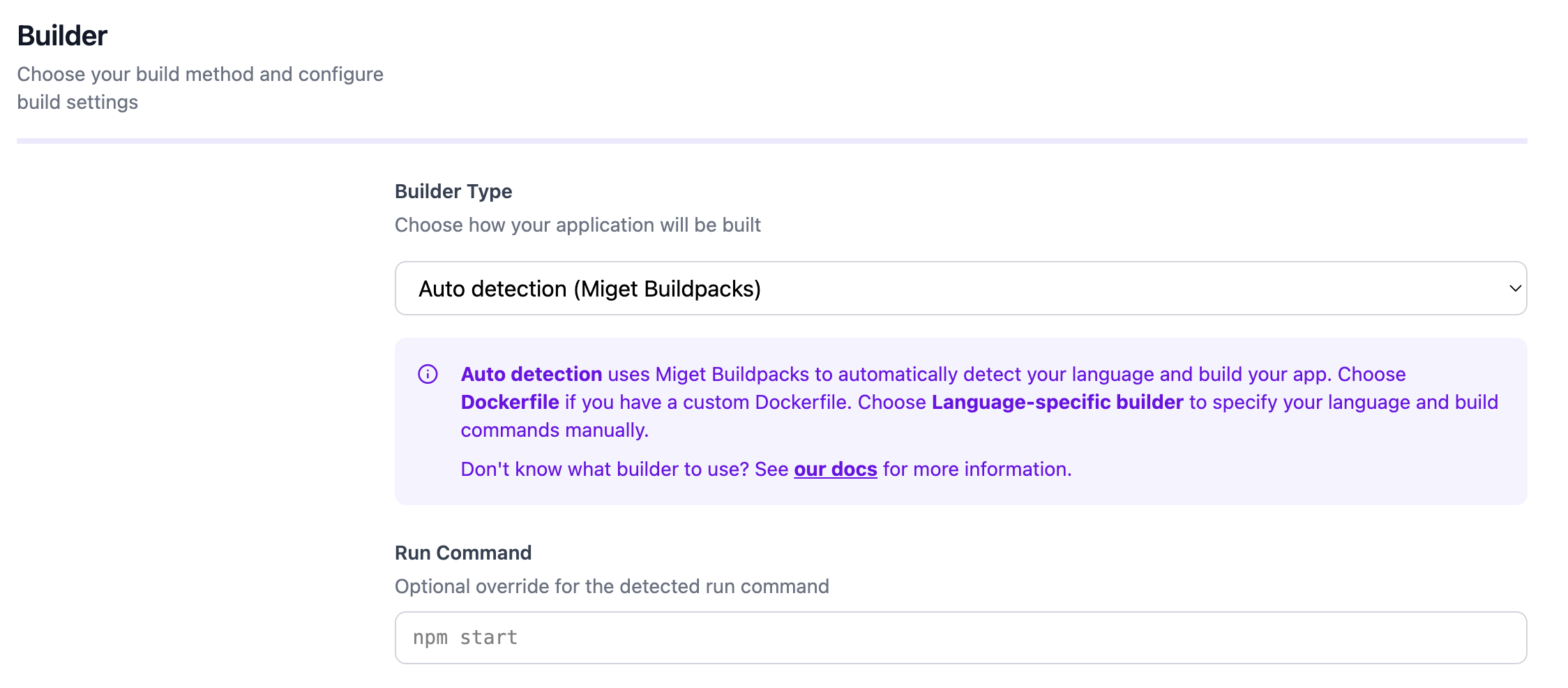
Miget Buildpacks automatically detect and build your Scala applications when you select **Auto detection (Miget Buildpacks)** as the build method. No configuration is required for most projects. For the full reference, visit the [migetpacks Scala documentation](https://migetpacks.com/languages/scala).
## Detection
Your application is detected as Scala when one of these markers is present in the root directory:
- `build.sbt`
- `build.sc`
- `project/` directory
## Version Detection
The versions are determined from the following sources:
- **Scala version** - `scalaVersion` setting in `build.sbt`
- **sbt version** - `sbt.version` property in `project/build.properties`
- **Java version** - `java.runtime.version` in a `system.properties` file at the root of your repository
```properties
java.runtime.version=21
```
## Build Process
During the build, the following steps are performed:
1. **Build environment** - The official sbt/Scala build image is used for compilation.
2. **sbt build** - Your application is compiled and packaged using sbt.
3. **Framework detection** - Play Framework and sbt-native-packager are auto-detected. If present, the appropriate packaging commands are used.
4. **Artifact packaging** - The build produces a runnable artifact (JAR or native package).
## Run Command
The run command is auto-detected based on your build configuration and any detected frameworks.
You can override the run command by defining a `web` process in a `Procfile` at the root of your repository. You can also override the run command directly in the Miget dashboard when creating your app or changing the deployment source.
 ## Configuration
You can customize the build and runtime behavior through the Miget dashboard and repository configuration files:
- **Environment variables** - Set under **Settings -> Variables** in the Miget dashboard
- **JAVA_OPTS** - Pass JVM flags such as memory settings (e.g., `-Xmx512m`)
- **Procfile** - Define the start command at the root of your repository
- **Project Path** - For monorepo setups, specify the subdirectory containing your application code in the **Advanced** tab
- **Pre-Deploy Command** - Run a command before deployment (e.g., database migrations) in the **Advanced** tab
- **Post-Deploy Command** - Run a command after successful deployment (e.g., seeding data, cache warming) in the **Advanced** tab
## Docker Hardened Images
You can enable Docker Hardened Images (DHI) in the **Advanced** tab when creating your app or changing the deployment source. When enabled, your application is built using distroless runtime images with a minimal attack surface, no shell, and no package manager.
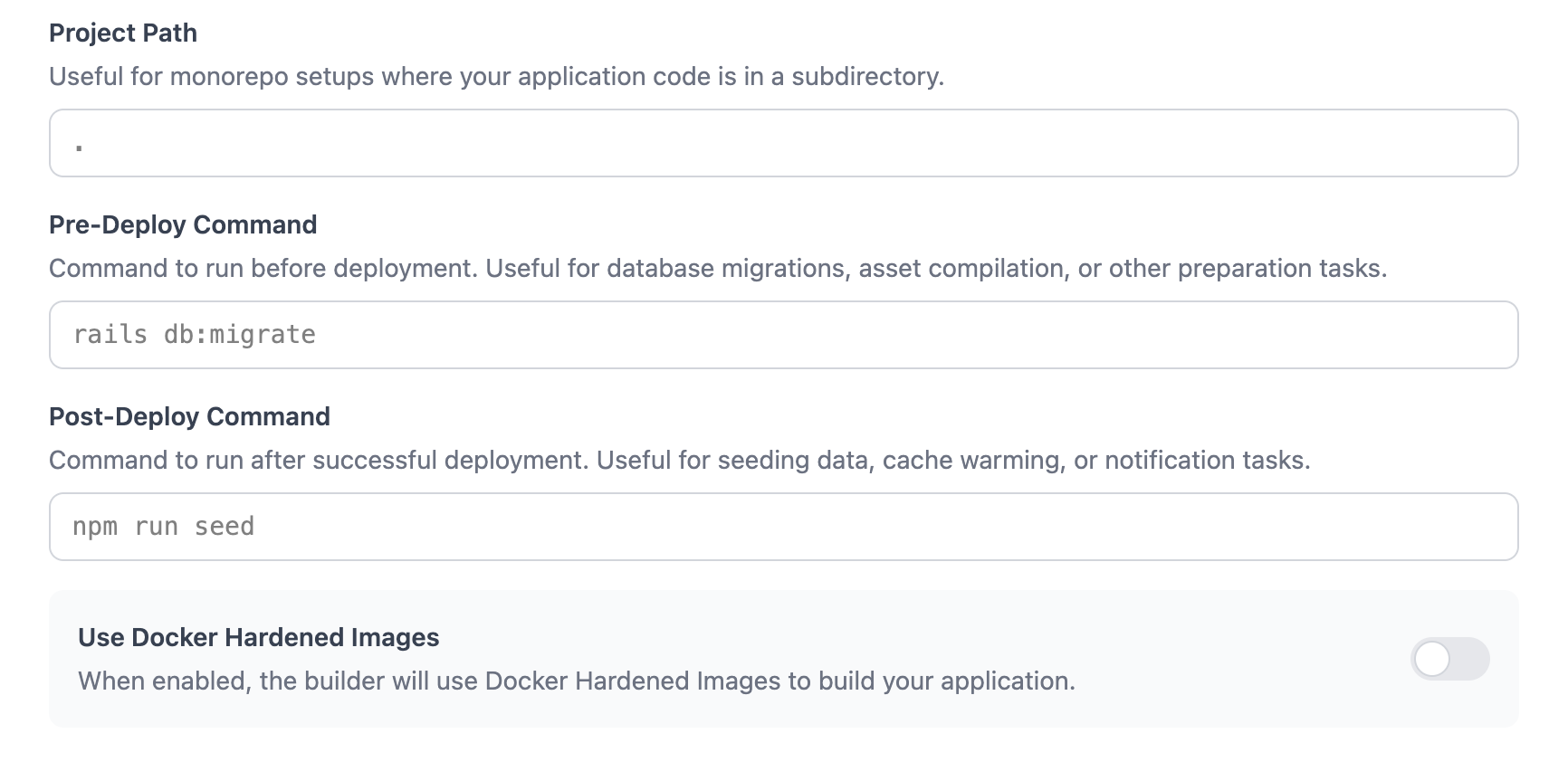 Scala uses a hybrid approach: the official sbt/Scala image is used for the build stage, and a DHI runtime image is used for the final container.
For the complete reference, see the [migetpacks Scala documentation](https://migetpacks.com/languages/scala).